
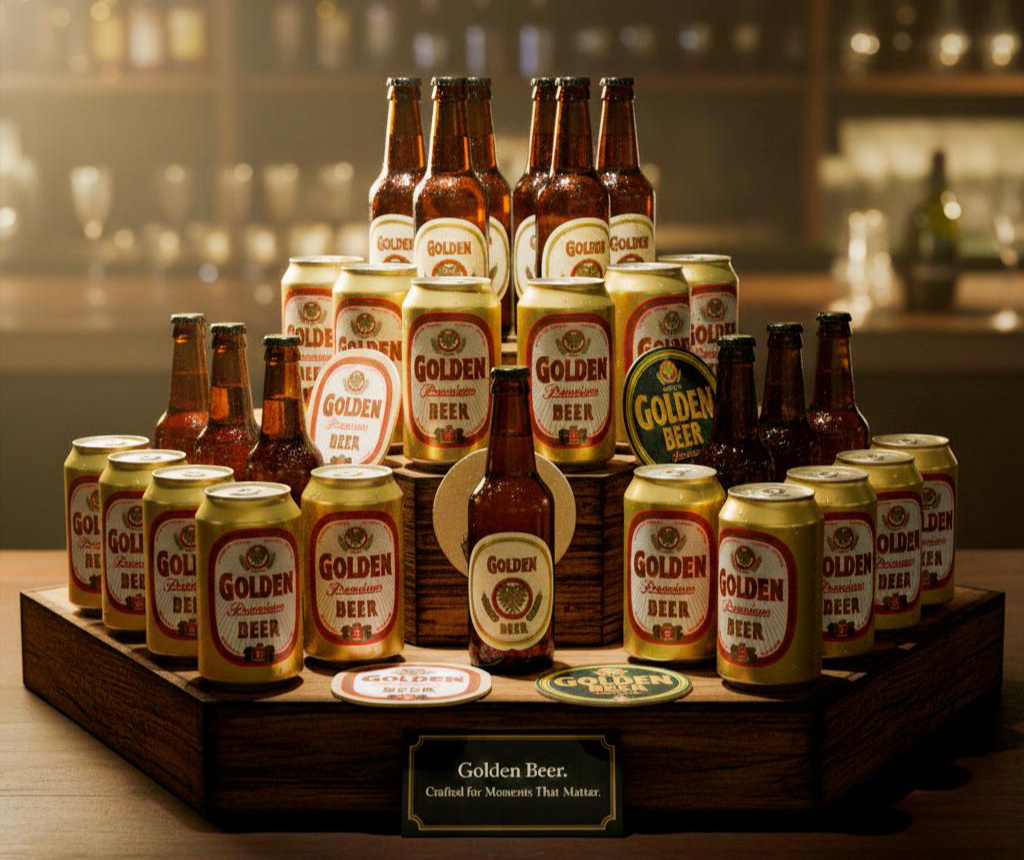
My introduction to Golden
I can still remember the first time Golden Beer caught my eye. It wasn’t a beer that demanded attention—not like Sagres or Super Bock with their confident, polished branding. Golden Beer sat quietly on shelves, its flat yellow label almost stubborn in its simplicity, the heavy black lettering as plainspoken as the people who drank it. In the early 1990s, when Terceira Island felt like its own small universe, Golden Beer was simply there—not advertised, not celebrated, but familiar in the way only the everyday can be.

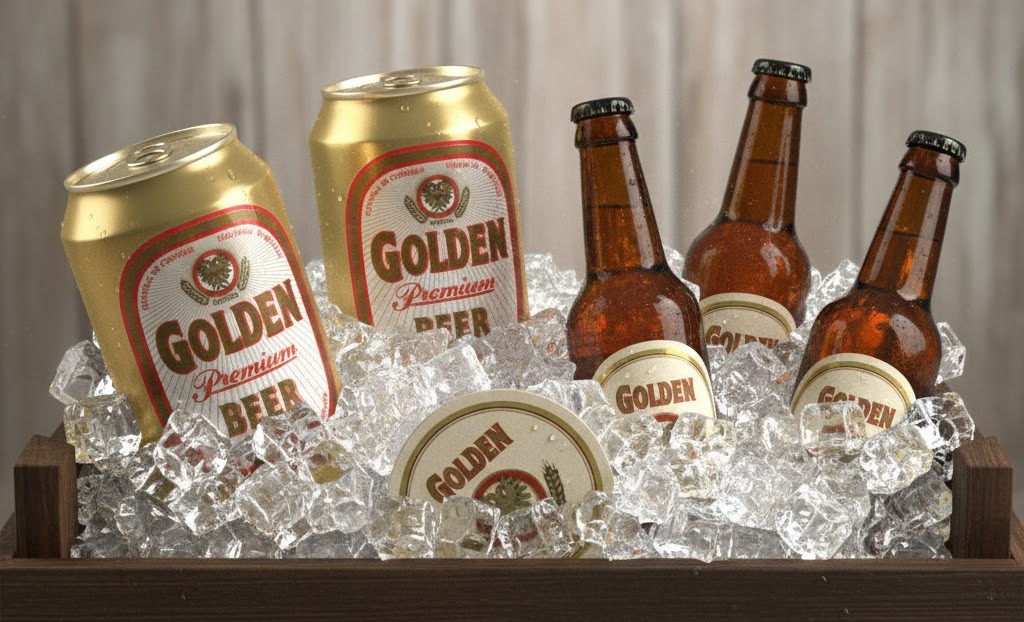
My strongest memories of it unfold under the summer sun during the touradas à corda. An old farm truck would rumble into place before the crowd gathered, the bed transformed into a makeshift bar. The truck’s deep chest freezer—tipped on its side or an old refrigerator laid flat—was filled with bottles buried in ice. Two men stood inside, never stopping, never putting down their bottle opener. They worked like machines, grabbing three bottles at a time, caps flying in rhythm: clink—clink—clink. Those sounds braided into the music of the afternoon: the shout of the crowd, the bell on the bull, the chatter of neighbors.
Golden wasn’t just for the day’s festas. It was the island’s night drink too. In discotecas like Lareira in Juncal, Baleia in Fonte Bastardo, or Twins in Angra do Heroísmo, Golden stood in the refrigerators behind the bar. We danced the night away to Sinead O’Connor and Enigma mixed into Euro-techno beats that pulsed through the speakers, fog machines hissing and lights spinning. Golden Beer was not a statement; it was the steady company of our weekends.

The Quiet Birth of a Quiet Beer
Golden Beer was launched in 1992 by Centralcer / Sociedade Central de Cervejas (SCC), the brewery behind Sagres. The brand appears only as a single line in SCC’s corporate timeline, a quiet marker of its presence. That silence is itself telling: this was a product meant to serve a function, not to be celebrated.
The early 1990s were a time of change for Portuguese industry. SCC was modernizing its operations, updating distribution, and recalibrating its product strategy. In that climate, value-tier brands are launched to protect flagship identities, test distribution mechanics, and occupy low-price segments. Golden Beer fit that mold: an everyday pale lager, brewed for consistency and price, not for awards.
Where Golden Beer Found Its Home
On the mainland, Golden Beer quietly appeared in cafés, small grocery shops, and local venues where the practicalities of price and supply mattered most. But the Azores tell a richer story. Islands have slower product turnover and distinctive distribution patterns; brands that fade on the continent often linger in island markets. Terceira kept Golden Beer alive in its festas, bars, and homes long after it grew scarce elsewhere. Collectibles and artifacts from the islands—glasses, cans, and mirrors—supply the visual evidence that mainland records do not.
Why It Disappeared
Golden Beer’s disappearance was gradual and without drama. SCC’s corporate restructuring and strategic refinement in the late 1990s and early 2000s prioritized stronger, higher-margin brands. At the same time, Portuguese consumer preferences began shifting toward premium labels, imports, and identity-driven marketing. Retail shelf-space became a battleground dominated by the major players, and low-velocity, low-margin SKUs were the first to be pruned. Golden Beer was a casualty of market evolution and corporate efficiency—it stopped appearing because the conditions that justified its production no longer existed.
What Survives
Only fragments remain: promotional glasses tucked in kitchen cabinets, cans that surface in collector sales, crown caps with manufacturing markings, a mirror salvaged from an old bar. More enduring are the memories—of cold bottles, the crack of the cap, the music in the discotecas, the shout at a tourada. Those sensations are the real legacy of Golden Beer.

Gaps in the Record
There are things we will likely never know: the exact recipe, the brewmaster’s name, internal sales figures, and the formal memo that ordered the brand retired. Those documents, if they existed, remained within SCC’s private archives. Golden Beer’s story is therefore a mix of what is documented and what memory preserves.
Even so, this article gathers the totality of open-source knowledge available today, combining corporate references, collector artifacts, and cultural memory to offer the most complete public account possible.
A Final Word
Golden Beer was never meant to be legendary. It was a common object in the lives of ordinary people: a festival companion, a nightclub staple, a drink in a café. Perhaps that ordinariness is its noblest quality. In remembering it, we remember a way of life.
drive:Terceira encourages responsible enjoyment. Never drink and drive.